How Do You Actually Reach Bávaro Beach from Cana Bay?
From Cana Bay, Bávaro Beach is a 5-minute drive rather than a walk out of the door, and the useful question is not the distance but the way in — where you park, which stretch you arrive on, and who looks after it. Riviera Bay sits behind the northern, Arena Gorda end of that shoreline, inside the Hard Rock Golf Club community. This guide covers what the Dominican public-shoreline rule really gives a buyer, and what to check before taking the word beachside on trust.
Why 'how far is the beach?' is only half the question
Bávaro Beach is one shoreline, not a collection of separate beaches. It runs almost unbroken along the east coast, and what changes as you move along it is rarely the sand — it is the arrangement in front of the sand. A hotel's raked frontage here, a club deck there, an open entrance between the two. Because the shoreline belongs to everybody by law, no address on this coast buys a beach. What an address buys is a way onto it.
That is why a figure on a brochure explains so little. A residence a short stroll from the water with nowhere to park, no shade and no path is further from a usable beach day than one a few minutes back with a base, a car park and somewhere to leave a towel. Framed that way the question becomes answerable, and it stops being about distance at all: which stretch, whose door, and who is looking after it this year.
Where Cana Bay sits along the shoreline
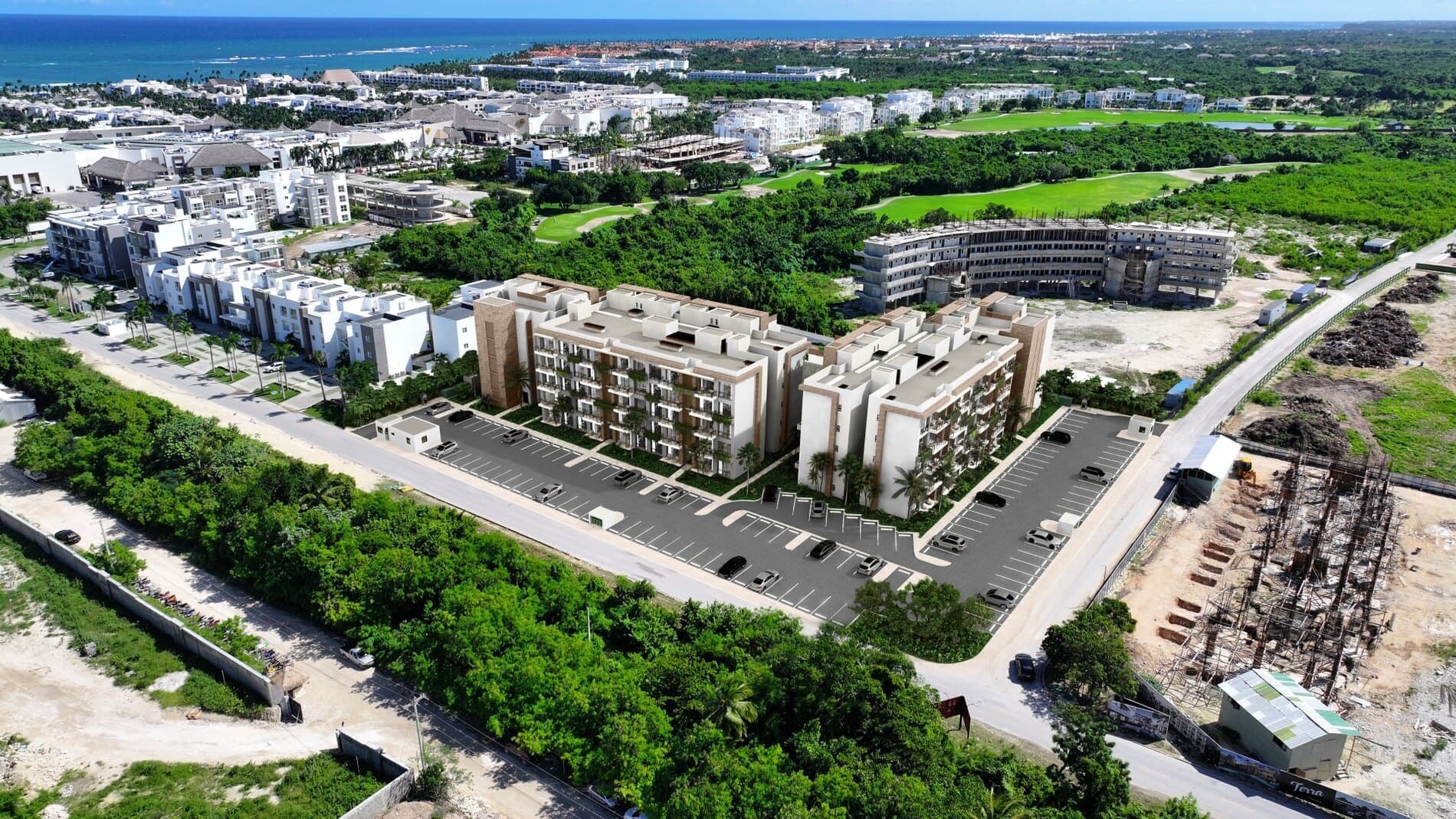
Cana Bay occupies the ground behind the northern end of the run, the sector known as Arena Gorda. That end reads differently from the middle of the strip: the beach is broad, the resorts are spaced further apart, and the breeze that firms up through the afternoon is steady enough that this is where the kite and windsurf schools set up. Riviera Bay's 110 furnished residences sit inside that community, beside the Hard Rock Golf Club, looking out over the lake and the fairways rather than over water.
From the gate the shore is a 5-minute drive, and Punta Cana International is about 20 minutes in the other direction — the same run you already make for arrivals and departures. Inside the community there is a residents' beach club with an infinity pool beside the Hard Rock, a resort pool at the centre of the plan, and private rooftop terraces. The honest way to put the trade is this: the sea is not outside the window here. A golf course is, and the water is a short drive and a parked car away.
What Dominican law settles at the water's edge, and what it leaves open
The shoreline itself is public property. Ley 305 of 1968, and the constitutional principle behind it, place the coastal strip — roughly the first 200 feet inland from the high-tide line — in public hands. It cannot be sold, it cannot be enclosed as private ground, and it cannot be acquired by anyone merely using it for long enough. So a stretch advertised anywhere in this country as a private beach is describing a standard of service, never a title.
What the rule does not settle is your arrival. The land behind that strip may be privately held, so the access road, the car park, the walkway and the furniture can all be controlled entirely lawfully by whoever owns them. Public title is a floor, not an arrangement for your afternoon. Certification works on the same logic: a Blue Flag — Bandera Azul locally — is awarded to one managed section of coast, generally a section run by a hotel or a club, and never to a whole beach by name. A certified section carries lifeguard cover and first-aid equipment, routine seawater testing, environmental information and equipment for accessible bathing; the section beside it may carry none of that, under the same beach name.
| What the shoreline rule settles | What it leaves to whoever runs the way in |
|---|---|
| The sand is public property, roughly the first 200 feet inland from the high-tide line. | Whether there is anywhere to park, change, eat or sit when you get there. |
| No owner and no hotel can lawfully turn that strip into private ground. | Who rakes, staffs and cleans the section you walk onto, and how often. |
| You may walk the length of the shore without asking permission. | Whether a particular property has a route to the water on foot at all. |
| The rule reads the same the whole length of the coast. | Certification and services attach to a managed section, not to a beach's name. |
Five things to check before you take the word beachside on trust
Beach access is the part of a coastal purchase that is most often assumed and least often written down. It turns into a short list of questions worth asking of any development on this coast, this one included — and the answers are far more revealing than a distance is.
None of them are hostile questions, and a straight answer to all five is itself a good sign. Where they cause trouble, it is usually because the access exists in a photograph rather than in a document.
-
Name the way in Ask which specific stretch of shore the property uses, and how you get onto it: a club, a shared path, a public entrance, or nothing in particular.
-
Ask who runs it A beach section is only as good as whoever staffs it, rakes it and empties the bins. Ask who does that, and whether owner and guest access is recorded in the community documents rather than described in a brochure.
-
Drive the route at the real hours Do the run early in the morning and again at the end of the day. A midday sales visit shows you the roads at their emptiest.
-
Look at the arrival, not the frontage Where does the car go, how far is the walk from it with a cool box and two towels, and is there shade at the end of it?
-
Ask what happens on a bad sea day Wind, a red flag or seaweed along the waterline ends a beach day on any Caribbean coast. Find out what the community holds inside its own gates for when that happens.
What a beach day looks like when you live behind the sand
It starts in the car, which sounds like a drawback until you have done it a few times. Towels, a cool box and an umbrella live in the boot instead of being carried down a corridor; the water is at its flattest early; and by the time the breeze has firmed up and the sand is hot, most owners are already heading back. Mornings at the water, afternoons behind the gate — that is the rhythm this geography quietly encourages, and it is the opposite of the one a beachfront room produces.
Back inside, the residences arrive furnished with working kitchens, from one-bedroom plans of 720 sq ft to three-bedroom layouts of 1,418 sq ft with terraces, so lunch is made at home rather than queued for. And when the sea is not cooperating — a windy week, a red flag, a line of seaweed at the waterline, all of which any Caribbean coast produces — the day moves to the resort pool, the infinity pool at the residents' beach club or a rooftop terrace, which is a large part of why those exist.
If guests will be renting from you, answer the beach question first
Every guest asks how far the beach is, and the answer they get before booking decides whether they arrive pleased or disappointed. From Cana Bay the true answer is short and specific: a 5-minute drive, a residents' beach club beside the Hard Rock, and a car that makes the whole thing easy. Guests who want to step out of a room onto sand should book a beachfront resort. Guests who want space, a kitchen, a pool that is not shared with a whole hotel and golf next door will take the drive without thinking about it twice.
Setting that expectation early is the cheapest thing an owner can do, and it belongs in the opening lines of a listing rather than in the small print. Riviera Bay's furnished residences start at $210,000, and the beach sentence deserves to sit right beside that figure — the guest, or the buyer, who understands the geography before committing is the one who is happy with it afterwards.
Common questions
- Is Riviera Bay on Bávaro Beach?
- It is behind the shoreline rather than on it. Riviera Bay sits inside the Cana Bay community at the Arena Gorda end of the Bávaro run, a 5-minute drive from the sand, with a residents' beach club and infinity pool beside the Hard Rock. Punta Cana International is roughly 20 minutes in the other direction.
- Can anyone walk on the beach in front of the hotels at Bávaro?
- Yes. Ley 305 of 1968 places the coastal strip — roughly the first 200 feet inland from the high-tide line — in public ownership, so the sand cannot be closed to anyone. What can be controlled is everything behind it: the entrance, the parking, the walkway and the sunbeds sit on land that may be privately held. That is why having a base to arrive at matters more day to day than the legal position does.
- Which part of Bávaro Beach is closest to Cana Bay?
- The Arena Gorda sector, at the northern end of the run. It is a broad stretch with the resorts spaced further apart than in the middle of the strip, and a steady afternoon breeze that suits kitesurfing. Certified sections there carry lifeguard cover, first-aid equipment and routine water testing — though certification attaches to a managed section rather than to the beach as a whole, so it is worth knowing which section you are using.
- Do I need a car to use the beach from Riviera Bay?
- Plan on having one. The shore is a 5-minute drive rather than a walk, and although taxis and the ride-hailing apps operating in Punta Cana cover the trip easily, most owners here keep a vehicle anyway — for the supermarket run and the airport as much as for the beach.
Want the details for your own situation?
Ask about availability, layouts or the buying process, and someone from the sales team will get back to you.
Get in touch