Can You Buy Dominican Citizenship? A Straight Answer From Cana Bay
No. The Dominican Republic does not offer citizenship by investment: no Dominican law grants nationality in return for a donation or a property purchase, and the island nation that does run such a programme is Dominica, a different country. What the Dominican Republic has is residency, including a route aimed at investors, and a naturalisation law, Law 1683 of 1948, under which residence comes first and citizenship remains a discretionary grant by the Executive afterwards. This page walks that path as it applies to someone buying a Riviera Bay residence at Cana Bay, from $210,000.
Why doesn't the Dominican Republic sell citizenship?
Because none of its laws provide for it. The statute that governs how a foreigner becomes Dominican is Law 1683 of 1948 on naturalisation, which the Ministry of Interior and Police still cites as the basis of the service today. Read end to end, it sets residence periods: a standard one for ordinary applicants and shorter ones for people who have married a Dominican, founded and kept up a business in the country, or own real property there. Not one of its clauses is a sum of money paid to the state or invested in the economy. There is no fund to contribute to, no approved-project list and no minimum ticket.
The only discretionary route is privileged naturalisation. The President may confer nationality by decree on a foreigner judged to have rendered eminent services to the Republic or outstanding services to humanity, and the law caps that at 5 people per calendar year. It is an honour conferred, not a product for sale, and the ministry's own list of naturalisation services — ordinary, by marriage and privileged — contains nothing resembling an investment option.
So where does the phrase come from? Very likely from Dominica, a separate island nation that search engines and buyers regularly confuse with the Dominican Republic, and which does run a citizenship-by-investment programme. The Dominican Republic does not offer one. What it offers is residency, and a naturalisation law that can follow it.
Where does residency by investment fit in?
Under the General Migration Law, a foreigner who comes to live in the country is either a temporary resident — admitted for up to 1 year at a time, renewable annually while the activity that justified the admission continues — or a permanent resident, entitled to reside indefinitely unless the status is cancelled. Investors appear in that law as a permanent-resident category: foreigners who contribute their own assets to activities of interest to the country, with the minimum left to regulation. The implementing regulation, in the text published by a Dominican law firm, sets that minimum at US$200,000. The migration authority's own web pages refused every attempt to open them, so read the figure as the threshold the programme is described as having rather than one checked at the source.
A permanent-residence card is first issued for 1 year and then renewed for periods of 4 years, and after ten years of lawful permanent residence the migration law provides for a definitive residence card. None of these stages is citizenship. They are permissions to live in the country, and a resident remains a national of wherever they came from.
Whether buying a condo counts toward the investor category is the question that matters most on a property site, and it is not settled. Sources conflict on whether real estate is accepted and at what amount — one international adviser describes a property route at US$500,000 — so no page, this one included, can tell you that a particular Riviera Bay purchase will be accepted. Many buyers will find the income-based routes of Law 171-07 simpler to assess, because they turn on a pension or passive income rather than on how a purchase is classified.
| Route | What the law or regulation asks | Where it leads |
|---|---|---|
| Investor (permanent residence) | Own assets contributed to activities of interest to the country; minimum described as US$200,000 | Residence; whether a condo purchase counts is unsettled |
| Rentista, Law 171-07 | Stable foreign passive income of at least US$2,000 a month | Residence |
| Pensionado, Law 171-07 | A foreign pension of at least US$1,500 a month | Residence |
| Naturalisation, Law 1683 | A period of residence, a complete file, an exam and an oath | Citizenship, if the Executive grants it |
How do Law 1683's residence periods treat a property owner?
This is the clause that makes the law relevant to anyone buying at Cana Bay. Law 1683 sets two years of uninterrupted residence as the ordinary requirement, but only six months for a foreigner who owns real property in the Republic — the same shorter period it gives to someone who has founded and kept up a business there, or who is married to a Dominican.
Three things about that clause are easy to overstate. First, the law states no minimum value for the property, so the shorter period is not something bought with a larger cheque; it attaches to ownership as such. Second, it shortens a residence requirement and nothing more: it does not replace the file, the exam or the oath described below, and it does not oblige the Executive to say yes. Third, sources are not settled on whether six months of uninterrupted residence means six months physically in the country or six months holding a residence permit, and for a buyer who lives abroad most of the year those are very different clocks.
The statute does add one rule about absences: trips abroad of no more than a year, made with the intention of returning, are counted as residence in the country. That helps someone who travels, but it does not answer the permit question above, and it is no reason to assume that owning a winter home here starts any clock. Treat every period on this page as a legal threshold to test against your own circumstances, never as a countdown to a passport.
What does a naturalisation application involve?
Naturalisation is handled by the Ministry of Interior and Police, and its published procedure shows how much more it is than a transaction. The application is opened online, the supporting documents are uploaded for review, and once the file is accepted the applicant presents the originals in person, where a photograph and fingerprints are taken. The ministry then calls the applicant to an exam on Dominican general culture, the file goes forward to the Executive, and the process closes with an oath ceremony at which the certificate of naturalisation is handed over. Under Law 1683 the grant itself is a decree published in the Gaceta Oficial.
The ministry's checklist asks, among other things, for a copy of the applicant's Dominican identity card, an apostilled birth certificate, criminal-record certificates and a notarised sworn declaration that fixes a domicile in the country and demonstrates economic solvency. Real property can appear in that declaration as evidence of solvency: the ministry lists title certificates, accompanied by a certificate of the property's legal status and a property-tax certification from the DGII, among the supporting papers. For a residence bought before completion, ask your attorney at what point a title certificate will exist that could be filed.
The ministry puts processing at roughly four to six months, counted from the day the originals and biometrics are lodged — its own handling time, not the time from your first arrival. And the law is explicit that meeting every condition is not the same as being entitled: the Executive may decline to grant naturalisation whenever it considers that appropriate.
-
Build the residence first Hold a lawful residence status and complete the residence period Law 1683 sets for your situation, with the paperwork to show it.
-
Apply online and upload Open the application on the ministry's portal and upload each required document; the ministry may ask for corrections before it accepts the file.
-
Originals and biometrics Present the originals in person, where your photograph and fingerprints are taken. The ministry's processing estimate runs from this visit.
-
General-culture exam Sit the exam on Dominican general culture when the ministry calls you.
-
Decision, decree and oath The Executive decides. If nationality is granted, the decree is published and an oath ceremony closes the process with the certificate of naturalisation.
What does Dominican citizenship change once granted?
The Dominican Constitution permits dual nationality in Article 20, so from the Dominican side a naturalised owner need not give up another passport; whether your current country lets you keep its nationality is a question for that country. The Constitution also sets two limits of its own: naturalised citizens may not stand for the presidency or vice-presidency, and they are not obliged to take up arms against their state of origin.
Less often mentioned is what the naturalisation law expects afterwards. Law 1683 allows the Executive to revoke a naturalisation if the person moves their domicile abroad within a year of obtaining it, or leaves the country and does not return within ten years. Dominican citizenship is designed for people who make the country their home, which is a different proposition from owning a holiday residence and visiting it.
Nor is any of this the same as tax residency. Holding a residence card does not by itself make someone a Dominican tax resident; the tax test turns on days spent in the country, and 182 is the figure it uses. Anyone planning to split the year between Cana Bay and home should have an accountant map both countries' rules before counting days.
What can a Riviera Bay buyer actually plan on?
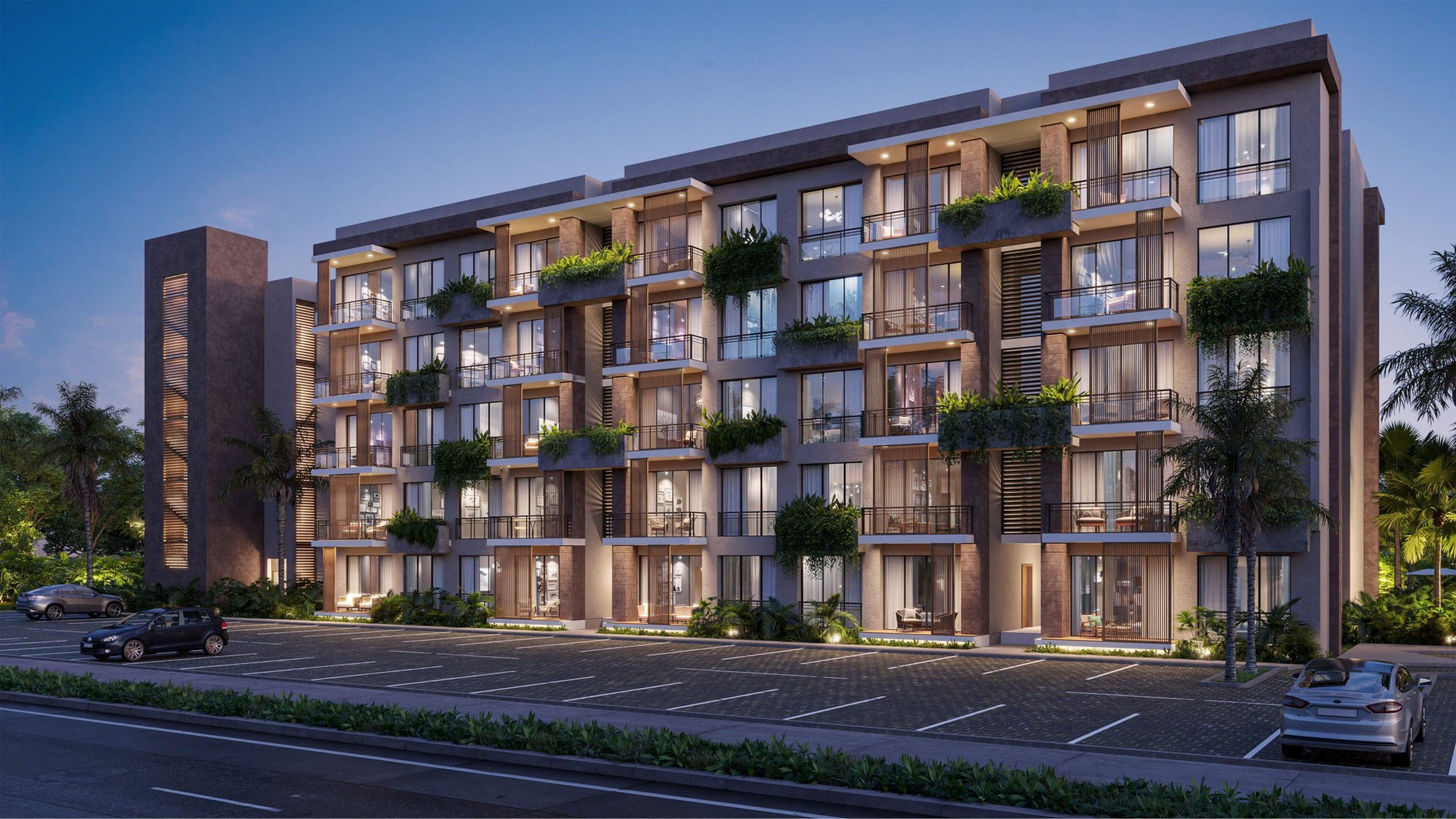
Buying at Riviera Bay gets you title to a home in the Cana Bay community: furnished residences from $210,000, beginning with a 720 sq ft one-bedroom layout, about 20 min by car from Punta Cana International Airport. It does not, by itself, get you a residence permit, and it does not get you a passport. Those are separate files with separate authorities — the Dirección General de Migración for residence, the Ministry of Interior and Police for naturalisation.
What ownership can do is play a documented part further down the line. It is the circumstance for which Law 1683 sets its shorter residence period, and it is the kind of asset the ministry accepts as evidence of solvency in a naturalisation file. If citizenship is a genuine goal rather than a search term, the sensible order is residence first, through whichever route fits your income and assets, then a period of real residence, then the application.
Take these questions to a licensed Dominican attorney before planning around any of it: which residence route fits your circumstances; whether, and from when, a purchase made before completion could be counted in an investor application; how the six-month clause for property owners is applied today; how your time abroad would be counted; and where you would stand for tax. This page describes the law as published. It is not legal advice, and nobody can promise you an immigration outcome in advance.
Common questions
- Is there a Dominican Republic golden passport or golden visa?
- There is no golden passport: the Dominican Republic does not offer nationality in exchange for an investment. The nearest thing is investor residency, whose minimum is described as US$200,000, and residence is permission to live in the country, not citizenship. The Caribbean programme that does sell citizenship belongs to Dominica, a different country.
- Does buying a Riviera Bay residence make me a Dominican citizen?
- No. Ownership gives you title to the home. Law 1683 sets a shorter six-month residence period for foreigners who own real property, but that only shortens a requirement: you still need lawful residence, a complete file, the general-culture exam and the oath, and the Executive may still decline. How a purchase bears on a residence application is unsettled, so ask a licensed Dominican attorney.
- Would I have to give up my current nationality?
- Not on the Dominican side: Article 20 of the Constitution permits dual nationality. Your own country's rules are a separate matter, so check them with its authorities before you apply.
- How long does the ministry take once an application is in?
- The Ministry of Interior and Police gives roughly four to six months, counted from the day the originals are lodged and the photograph and fingerprints are taken. That is processing time only. It follows the residence period, which comes first and depends on your situation.
Want the details for your own situation?
Ask about availability, layouts or the buying process, and someone from the sales team will get back to you.
Get in touch