Apartments for Sale in Punta Cana: What Actually Separates One Layout From the Next
Somebody searching for apartments for sale in Punta Cana, Dominican Republic is usually past the daydream stage and into the part where the choices have to be made: how many bedrooms, how much floor area, which side of the building, and what is inside the home on the day it is handed over. A grid of photographs answers none of that. This page is written from inside one development — Riviera Bay, 110 residences at Cana Bay — and it is about the apartment as an object you have to live in or let, rather than about anybody's inventory. It ranks nothing and lists nobody else's buildings.
What the word apartment is actually doing in this market
In listings written for this coast, apartment, condo and residence all point at the same object, and the interchangeable vocabulary hides a question worth settling before you look at a single floor plan. A home stacked among others, reached through a shared entrance, with private outdoor space of its own and a share of everything the building runs for the people who live there. The first half is the part buyers study. The second half is the part that keeps arriving after the keys do.
The form has a legal name here. A Dominican building becomes a set of separately-owned homes by registering a condominium regime — the mechanism set out in Ley 5038 of 1958, as modified by the Real Estate Registry Law 108-05 — and it is that registration, not the architecture, that constitutes each apartment as a property in its own right with functional independence from its neighbours. A building is not a set of apartments because it looks like one; it is one because the registry says so.
So the question this page answers is the narrower and more useful one. Given that the legal shape is settled, what are you choosing between when you choose a layout? At Riviera Bay that choice runs across three published residence types, and the differences between them are not the ones a square-foot comparison surfaces.
One, two or three bedrooms — and what each is really for
Riviera Bay publishes three residence types, and the ladder between them is short enough to hold in your head. A one-bedroom of roughly 720 sq ft. A two-bedroom of roughly 1,211 sq ft. A three-bedroom of roughly 1,418 sq ft. Each of the published types carries a terrace, which matters more here than the raw area does, and that is the point this section is building towards.
Read them as a sequence rather than as three unrelated products and they describe three different uses. The one-bedroom is a complete home for one or two people with the living space arranged as a single room — a home that is simple to close up and leave, simple to clean, and easy to hand to a couple who came for the beach and the golf. The two-bedroom is the first layout where two parties can genuinely be in the home at once without negotiating for the sofa. The three-bedroom is the layout that stops being a base and starts being a house: the one where a family, or a family plus visitors, can each keep a door of their own.
None of that is a recommendation. It is the set of questions the area answers, and the honest way to use a floor plan is to work backwards from how many mornings a year the home has to absorb more than two people.
The step between layouts is bigger than one extra room
The temptation is to treat the ladder as arithmetic: one bedroom, two bedrooms, three, with area attached. It behaves differently in practice, because the extra area does not all go into the bedroom that gives the layout its name. It goes into the distance between the places people sit, sleep and cook, and separation is the thing a shared home either has or does not.
Between roughly 720 sq ft and roughly 1,211 sq ft the change is qualitative rather than incremental: a second private room, and a living area large enough that somebody can be asleep while somebody else is awake. Between roughly 1,211 sq ft and roughly 1,418 sq ft it is a third door plus circulation, which is what turns a home that can host into a home that can host comfortably and repeatedly.
| Published layout | Approximate area | What the extra area really buys | The question it settles |
|---|---|---|---|
| One bedroom | 720 sq ft | A complete home with one private room and a single living space | Can two people live here easily and leave it easily? |
| Two bedrooms | 1,211 sq ft | A second private room plus a living area that survives two schedules | Can two parties be here at once without negotiating? |
| Three bedrooms | 1,418 sq ft | A third door and the circulation that keeps the rooms apart | Can a family plus visitors all keep a door of their own? |
The terrace, the outlook and the roof
Two apartments with the same published area can be very different homes, and in this climate the reason is usually outdoors. A terrace is not a balcony bolted on for the brochure; for most of the year it is the room the household actually uses at breakfast and at dusk, and its depth, its orientation and whether it takes the afternoon sun decide whether it gets used or becomes storage. Every one of Riviera Bay's published residence types carries one.
What the terrace faces is a second variable, and it is site-specific rather than plan-specific — the same layout in two positions is two products. Riviera Bay sits inside the Hard Rock Golf Club community at Cana Bay and publishes lake and golf-course views, so the outlook question here is which of those a given residence looks over, and what stands between it and the view five years from now.
Above the apartments, the development publishes rooftop terraces alongside a residents' beach club, an infinity pool and a resort pool. That is worth separating out when you compare homes: part of the living space you get here is not inside your own front door, and an apartment with a modest interior inside a building that runs generous shared space can live larger than a bigger apartment in a building that runs none.
What is inside the apartment on handover day
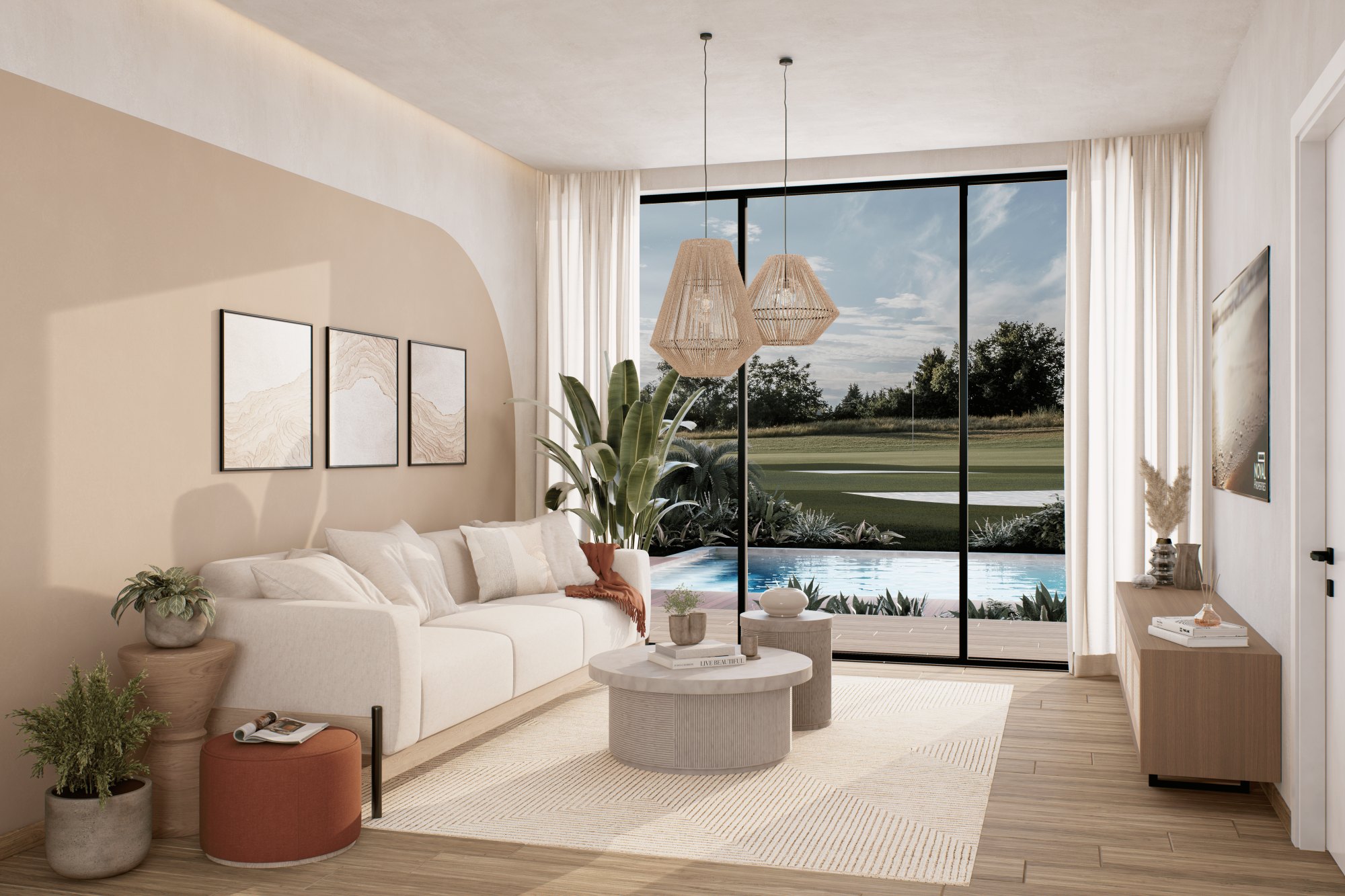
Here is where a comparison between two apartments most often goes wrong, because the two sides of it are not the same object. Riviera Bay publishes every residence as delivered fully furnished, finished in the development's Tulum-inspired style, with the furniture, the kitchen, the fixtures and the soft goods included. There is nothing to specify, source, ship through customs or install afterwards.
That matters in two directions at once. It takes a real cost and a real project off the buyer and folds both into the home, so the figure you are looking at is a finished, usable residence rather than a shell with a second bill behind it. And it removes the gap between handover and use — the home works on day one, whether the person walking in is the owner or a guest.
Say the obvious thing plainly, though: this is a pre-construction development, so the interiors on this page and on the rest of this site are renderings, not photographs of finished rooms. Read them as the specification the developer is committing to, and ask for that specification in writing rather than inferring it from a picture. That is good practice with any unbuilt home anywhere.
What a foreign buyer is acquiring here
Short, because it is less complicated than the search results suggest. Nothing in Dominican law bars an overseas purchaser from owning here. You buy in your own name, you receive registered freehold title, and the terms are the ones a Dominican citizen gets — no nationality test, no residency condition and no permission to secure before you start. The presidential approval that a far older decree once demanded was abolished in 1998 and has not existed since.
What you take title to is the apartment itself, together with an undivided share of the parts of the building that serve everybody. The tax treatment of the purchase, and of any income it later earns, is a separate conversation, and the right person to have it with is a Dominican attorney who has read your specific contract — not a page, including this one.
Six questions that separate two apartments faster than a price list
Take these to any apartment you are looking at on this coast, including this one.
- Which community is the address actually in? Punta Cana in a listing covers several distinct communities; Riviera Bay is at Cana Bay, on Bávaro Beach, with the golf club on-site, the beach published at 5 minutes and Punta Cana International Airport at 20.
- Where does this exact residence sit in the building? Floor, aspect and what the terrace faces change the home more than the plan name does.
- How deep is the terrace, and when does the sun reach it? An outdoor room you cannot sit in at five o'clock is not an outdoor room.
- What is handed over, in writing? If furnishing is included, the specification should be listed, not implied.
- What does the building run, and who pays for it monthly? Shared pools, a beach club and grounds are bought once and paid for continuously.
- What has this developer finished before? On an unbuilt home the completed record is the evidence; here the developer is Noval Properties, building in the Dominican Republic since 2003.
Common questions
- What sizes do apartments in Punta Cana actually come in?
- There is no single answer for the area as a whole, so the useful version is a real published range from one development. Riviera Bay's three residence types run from roughly 720 sq ft for a one-bedroom, through roughly 1,211 sq ft for a two-bedroom, to roughly 1,418 sq ft for a three-bedroom, and each of them carries a terrace. Treat that as a reference point for reading other floor plans rather than as a standard: sizes on this coast vary widely, and a figure quoted without saying whether it includes outdoor space is not comparable to one that does.
- Is the difference between a one-bedroom and a two-bedroom just the extra bedroom?
- No, and that is the most common misreading of a floor plan. At Riviera Bay the step from roughly 720 sq ft to roughly 1,211 sq ft adds a private room, but it also adds living area, and the second thing is what changes daily life: it is the difference between a home where one person being asleep constrains everybody, and a home where two schedules can run at once. If the home will ever hold more than two people at a time, that separation is worth more than the door.
- Does the price of an apartment here include what is inside it?
- At Riviera Bay, yes — every residence is published as delivered fully furnished in the development's Tulum-inspired style, with furniture, kitchen, fixtures and soft goods included, from $210,000 USD. That is not universal on this coast, which is exactly why it belongs in any comparison: a furnished home and an unfurnished one are two different objects, and reading their figures side by side without saying so produces a conclusion that is simply wrong.
- If a listing says Punta Cana, is the apartment in Punta Cana itself?
- Not necessarily, and it is worth asking early. Punta Cana is used loosely for a stretch of the eastern Dominican Republic containing several distinct communities, each with its own access, its own facilities and its own daily rhythm. Riviera Bay's address is Cana Bay, on Bávaro Beach, inside the Hard Rock Golf Club community — golf on-site, the beach published at 5 minutes and the airport at 20. Ask any seller to name the community, not the region.
Want the details for your own situation?
Ask about availability, layouts or the buying process, and someone from the sales team will get back to you.
Get in touch