What Does 'Beachfront' Actually Buy You in the Dominican Republic?
Beachfront is one of the few words in a property listing with a hard legal edge behind it. The Dominican shoreline is public property and cannot be sold to anybody, so no title on this coast — however expensive, however close to the water — includes the sand. What varies from one coastal address to the next is where the parcel line falls, what stands on the public strip in front of it, and under whose permission. This guide explains that boundary, then states plainly where Riviera Bay, at Cana Bay in Punta Cana, sits in relation to it.
One word covering four quite different arrangements
Read enough coastal listings in this country and you start to notice the same adjective attached to properties with almost nothing in common. A house whose garden ends where the public strip begins. A building across a service road from the sand. A residence inside a resort community whose club occupies a stretch of shore some distance away. A condominium several minutes inland with a shuttle and a cabana arrangement. All four are routinely described with the same word, and the word is doing four different jobs.
What none of the four includes is the beach itself, because the beach is not in anybody's title to include. Once that is clear, a coastal listing becomes readable. You are being told about a position — how far the parcel line lies from the water — and about an arrangement covering the ground in between. Both of those are checkable against documents. The adjective is not checkable against anything.
| What the listing says | What it can legitimately describe | What it can never include |
|---|---|---|
| Beachfront | A parcel whose boundary runs up to the edge of the public strip | The strip itself, or any part of the sand in front of it |
| Private beach | A managed stretch that is staffed, furnished and cleaned | Title to that stretch, or a right to close it to anyone |
| Beach club | A facility standing on public ground under an authorised use | An authorisation that travels to a buyer's apartment by itself |
| Beach access | A path, a gate, a shuttle or a membership arrangement | Proof that the arrangement is written into your own documents |
Where private title stops, and why every parcel here begins inland
Ley 305 of 1968 places the coastal strip in the public domain: roughly the first 200 feet of land measured back from the high-tide line, along the entire coast. Public domain is a strong form of ownership. The strip cannot be sold, it cannot be enclosed as private ground, and it cannot be acquired by anyone merely for having used or occupied it long enough. A registered parcel on this coast therefore begins behind that line — which is the whole reason that even the grand seafront villas of this coast stand set back from the water rather than on it.
Nor is it only a sea rule. The same public treatment reaches the margins of rivers, lakes and lagoons, so a parcel offered as riverfront runs into an equivalent line before it reaches the water.
For an apartment the arithmetic is identical, one layer down. Under the registry law the land beneath a condominium is held in common and undivided between all of its owners, so a unit's share of the ground is a share of a parcel that already stops where the public strip starts. The buyer's nationality changes none of this: a foreign purchaser takes registered freehold on the same terms as a Dominican, with no approval step, the old requirement to obtain presidential consent before buying having been abolished in 1998. Foreigners can own on this coast as completely as anyone. What nobody owns is the beach.
So why are there buildings on the sand at all?
If the strip cannot be owned, the obvious question is how clubs, jetties and thatched bars come to stand on it. The answer is that its use can be authorised rather than sold. Permission is granted case by case by the Executive, as an exception, for tourism and other public-utility purposes, and it arrives as a specific decree naming the applicant and the works it may carry out. These are not historical curiosities. One was issued earlier this year allowing a company to build a beach club on part of the strip in La Altagracia — the province that contains Punta Cana.
Two things follow, and together they are the practical heart of this page. First, a structure on the sand is somebody's permission, not an asset attached to your apartment: it is held by an operator, on terms, and it does not become yours because you bought nearby. Second, the useful question about a photograph of a beach club is never who owns it. It is what authorises it, who holds that authorisation, and whether anything in the papers you are being asked to sign gives you and your guests the use of it.
Three positions on this coast, and the trade each one makes
Hard against the strip. The parcel boundary runs to the public line and nothing stands between the building and the sand but the strip itself. You get the water at the end of the garden, and you also get the most exposed position on the property — salt, wind and everything a Caribbean coast throws at glass, fixings and metalwork. It is also the position that asks most of a maintenance budget, year after year.
Inside a resort community with a facility on the shore. The residence is set back while a club, deck or restaurant on the strip is run by the community or by an operator. Here the arrangement is the asset — who may use it, whether guests may, whether anything is charged — and it lives in documents rather than in the view.
Set back on inland or golf-course ground. The water is a drive rather than a doorstep, and what the address buys instead is space, quieter ground, less exposure to the sea and usually more building for the money. The trade is real and it runs both ways. This page makes no claim about which of the three lets better, because nothing published here measures that.
Whichever of the three is in front of you, the documents matter more than the photographs — and on this coast the photographs are almost always taken from the beach, looking back.
Where Riviera Bay sits, said plainly
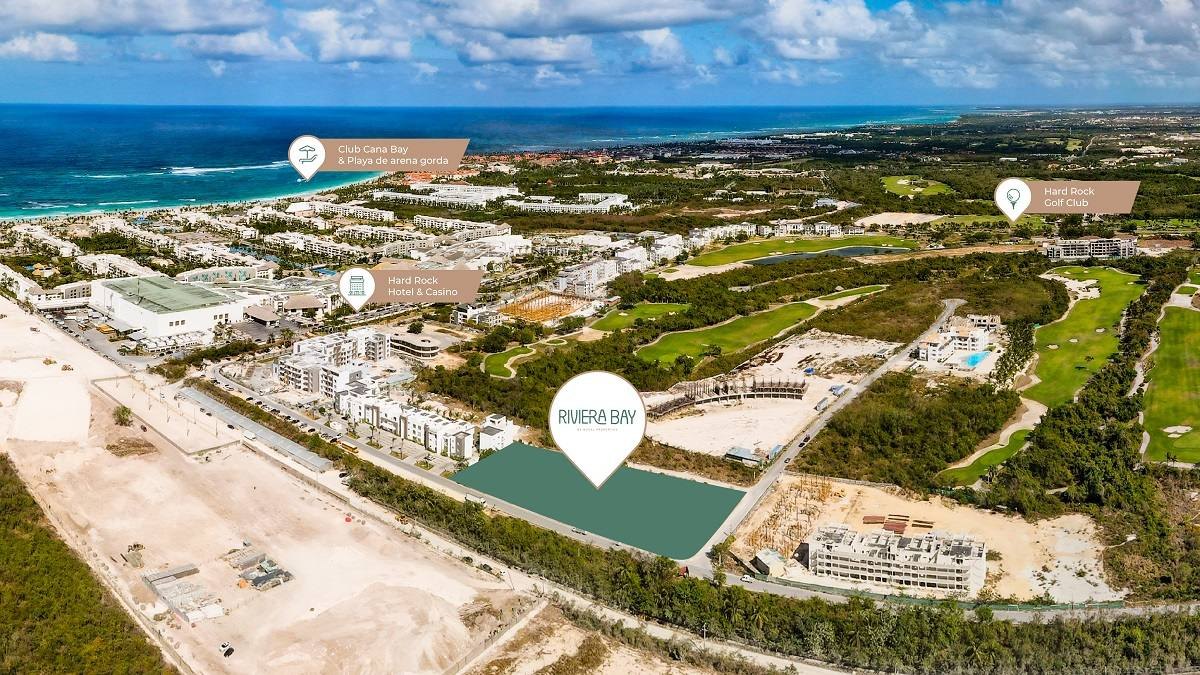
Riviera Bay is not beachfront, and this page will not use the word about it. The development is set back inside Cana Bay, on golf-course ground beside the Hard Rock Golf Club, with its outlook over the lake and the fairways rather than over water. The drive times published for the site are Bávaro Beach at 5 minutes and Punta Cana International at 20, and the community it sits within carries a residents' beach club with an infinity pool alongside a resort pool.
The rest, offered for placing it rather than selling it: 110 fully furnished residences, one-bedroom layouts from 720 sq ft up to three-bedroom plans of 1,418 sq ft with a terrace, and prices from $210,000. The 12–15% return shown on this site is published as a projection, so treat it as one and ask for the assumptions underneath rather than reading it as an outcome. If your requirement is genuinely to open a door onto sand, none of the above changes the answer — and it is far better to know that before a flight is booked than after.
Testing a beachfront claim on paper
Everything above reduces to four questions that are answered in documents rather than in conversation. None of them is an aggressive question; anyone selling properly will have the answers to hand, and on this coast those answers are far more informative than the adjective could ever be.
-
Read the parcel, not the photograph Ask for the registered parcel and its plan, and for where the boundary lies in relation to the public strip. A drawing settles in a minute what a marketing word cannot settle at all.
-
Ask what stands on the strip, and under what authority If a club, a deck or a jetty occupies the sand, ask what authorises it, who holds that authorisation and on what terms. A permission held by an operator is not part of what you are buying.
-
Ask what your own documents give you Owner and guest use of any shore facility either appears in the condominium's rules and in the sale contract, or it exists only in a brochure. Ask to read the clause itself.
-
Ask what the upkeep is written to assume Salt, wind and storm season are hardest on whatever stands closest to the water. Ask what the building's maintenance budget is meant to cover, and who decides when it rises.
Common questions
- Can a foreigner buy beachfront property in the Dominican Republic?
- A foreigner can buy Dominican property on the same terms as a Dominican national, in their own name and with registered freehold title, and there is no approval step — the old requirement for presidential consent before a purchase was abolished in 1998. What no buyer of any nationality can acquire is the beach itself: Ley 305 of 1968 holds the shoreline strip in the public domain, so every private parcel on this coast begins behind it. Nationality is not the limit here. The shoreline is.
- How far inland does the public shoreline strip reach?
- Roughly the first 200 feet measured back from the high-tide line, along the whole Dominican coast, and the same public treatment reaches the banks of rivers, lakes and lagoons. It is the reason buildings on this coast stand set back from the water. Treat the figure as the shape of the rule rather than a distance you can pace out: where the line actually falls on a particular parcel is a question for the registered plan and a licensed surveyor, never for a brochure.
- Are there private beaches in the Dominican Republic?
- No, and the phrase describes service rather than title. The sand cannot be sold, fenced off as private ground or acquired through long use, so a 'private beach' is really a managed stretch — staffed, furnished, cleaned — usually run by a hotel or a club, and often standing on public ground under a decree authorising that particular use. The stretch itself remains public. What is genuinely controlled is the land behind it, and with it the way in.
- Is Riviera Bay beachfront?
- No. Its 110 furnished residences are set back inland at Cana Bay, on golf-course ground beside the Hard Rock Golf Club, looking over the lake and the fairways. The site publishes Bávaro Beach at a 5-minute drive and Punta Cana International at 20 minutes, and the community carries a residents' beach club with an infinity pool alongside a resort pool. Prices start at $210,000 for a one-bedroom of 720 sq ft. If waking up above the sand is the requirement, this is the wrong address — which is better said here than discovered later.
Want the details for your own situation?
Ask about availability, layouts or the buying process, and someone from the sales team will get back to you.
Get in touch